
Summary
- The housekeeping agency is primarily responsible for executing contracted cleaning activities, deploying trained manpower, and maintaining effective supervision.
- The client organization must establish clear expectations, communicate inspection requirements, and monitor contractual performance.
- Preventing repeated failures requires documented inspections, root cause analysis, timely corrective action, and continuous performance monitoring.
A failed housekeeping inspection can raise an important question: who is accountable when cleaning standards are not met in a facility managed by an outsourced housekeeping service provider? While the housekeeping agency is responsible for deploying trained staff, maintaining hygiene standards, and ensuring that assigned tasks are completed, the responsibility does not always rest with the service provider alone. The client organization also has a role in defining expectations, communicating inspection requirements, and monitoring service delivery.
In outsourced facility management, accountability depends on the contract, the nature of the failure, the responsibilities assigned to each party, and the corrective actions taken after the inspection. Understanding these responsibilities helps organizations prevent repeated lapses, maintain workplace hygiene, and ensure that housekeeping services meet agreed standards TFTS a housekeeping agency to offices, hospitals, hotels in Delhi, Gurugram and NOIDA.
1. Is the Housekeeping Agency Directly Responsible for a Failed Inspection?
The housekeeping agency carries the primary operational responsibility for delivering the services specified in its contract. This includes deploying adequate manpower, providing trained cleaning personnel, supplying or arranging agreed cleaning materials, and ensuring that daily housekeeping activities are completed according to the prescribed schedule.
If an inspection identifies dusty surfaces, unclean washrooms, overflowing waste bins, improperly maintained common areas, or missed cleaning schedules, the agency may be held accountable when these failures fall within its contractual scope.
The agency is also expected to have a supervisory system in place. Supervisors should conduct routine checks, maintain cleaning records, identify shortcomings, and ensure that housekeeping personnel follow established standard operating procedures (SOPs).
However, responsibility should be determined by examining the specific inspection findings rather than automatically attributing every failure to the housekeeping workforce.
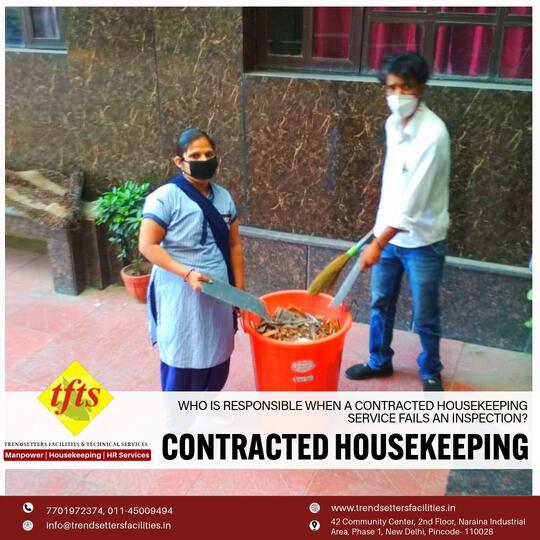
“Quality housekeeping is not just about completing cleaning tasks; it is about building a system of accountability where every responsibility is defined, every shortcoming is addressed, and every hygiene standard is consistently maintained.” Says Mr. Atul Mahajan, Director of Trendsetters Facilities and Technical Services a housekeeping services company in India.
2. Does the Client Organization Share Responsibility for Housekeeping Failures?
Yes, the client organization also has responsibilities, particularly when it comes to defining service expectations and monitoring performance.
A housekeeping contract should clearly establish the scope of work, cleaning frequency, hygiene benchmarks, manpower requirements, inspection parameters, and reporting procedures. If these expectations are unclear, inconsistent, or frequently changed without formal communication, the service provider may struggle to deliver the expected results.
The client must also provide reasonable access to the areas that require cleaning, communicate operational changes, and inform the service provider about specific inspection requirements.

For example, if a facility introduces additional cleaning requirements for a high-traffic area but does not communicate these changes to the housekeeping agency, accountability for the resulting shortfall may need to be shared.
Effective housekeeping management therefore requires cooperation between the client and the contracted service provider.
3. What Happens After a Housekeeping Service Fails an Inspection?
A failed inspection should trigger a documented corrective action process rather than simply result in warnings or penalties.
The first step is to identify the exact areas where cleaning standards were not maintained. The inspection report should record the observations, location, nature of the deficiency, and applicable contractual requirement.
The housekeeping agency should then investigate the reason behind the failure. Possible causes include staff shortages, inadequate supervision, insufficient cleaning materials, poor training, or non-compliance with established procedures.
Depending on the contract, the corrective action process may include:
- Deficiency reporting: Documenting inspection failures with photographs, observations, and specific locations.
- Root cause analysis: Identifying whether the issue resulted from manpower gaps, inadequate supervision, poor training, or resource shortages.
- Corrective action: Re-cleaning the affected areas and addressing the immediate deficiencies.
- Preventive measures: Revising cleaning schedules, conducting staff training, and increasing supervisory inspections.
- Performance review: Monitoring subsequent inspections to establish whether the corrective measures have been effective.
Repeated failures may also lead to contractual penalties, service-level agreement (SLA) deductions, or other consequences, depending on the terms of the agreement.
4. How Can Organizations Prevent Repeated Housekeeping Inspection Failures?
Preventing repeated inspection failures requires a structured monitoring system supported by trained personnel and accountable supervision.
Organizations should establish measurable cleaning standards instead of relying on general instructions such as maintaining cleanliness or ensuring proper hygiene. For example, washroom cleaning frequency, waste disposal schedules, floor maintenance, and high-touch surface disinfection should have clearly defined procedures.
Housekeeping agencies should also implement regular supervisory inspections and maintain documented checklists. Digital inspection records, where appropriate, can help track recurring issues and identify areas requiring additional attention.
Regular coordination meetings between the client facility management team and the housekeeping agency can further improve service delivery.
Most importantly, organizations should evaluate housekeeping performance based on consistent service quality, not merely the number of personnel deployed.
Key Responsibilities in a Contracted Housekeeping Arrangement
The following table highlights how responsibilities are generally distributed between the housekeeping agency and the client organization.
| Responsibility | Housekeeping Agency | Client Organisation |
|---|---|---|
| Manpower and Training | Deploy and train staff | Define staffing expectations |
| Cleaning Standards | Execute agreed cleaning tasks | Specify and communicate standards |
| Supervision and Inspection | Conduct routine checks | Monitor contractual performance |
The precise division of responsibilities depends on the signed contract, SLA, and applicable operational requirements.
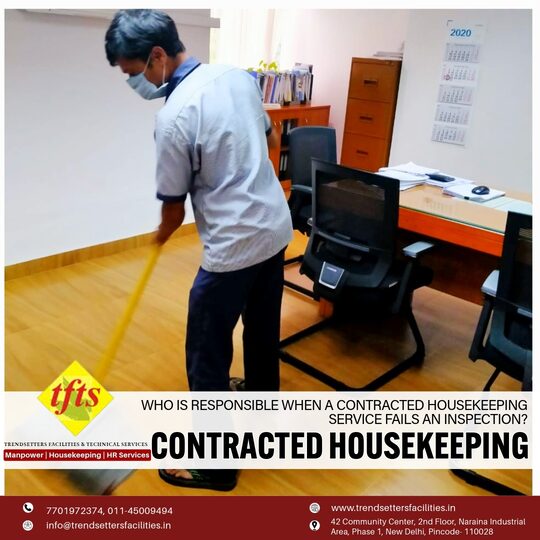
Why Accountability Matters in Housekeeping Management
A failed housekeeping inspection should not be treated as an isolated cleaning problem. It can indicate weaknesses in supervision, workforce management, communication, or contractual monitoring.
As an experienced facility management service provider, TFTS (Trendsetters Facilities & Technical Services Pvt. Ltd.) recognizes that maintaining hygiene standards requires more than deploying housekeeping personnel. It requires trained manpower, active supervision, systematic inspections, and a clear accountability framework.

Trendsetters Facilities & Technical Services (TFTS) is India’s leading manpower & temporary staffing agency for the manufacturing, power, hospitality, automobiles, IT, and Banking sectors. At present TFTS is the leading manpower supplier to Indian SEZs in SIDCUL, Rudrapur, Udhampur, Haridwar, and JAIPUR World. Some of the prestigious TFTS clients are Delhi Metro Rail Corporation, Bajaj Automobiles, Reliance Infrastructure, Haldirams, HCL.
Trendsetters Facilities & Technical Services (TFTS) offers a range of high-quality services from a team of specialized technicians for –
Life Maintenance and Repair
Housekeeping Services for Homes, Offices, Industries, and Institutions.
HR Outsourcing
Payroll outsourcing services
ITI Certified CNC Operators
Certified TIG welders,
Marble polishing services,
Fire hydrant system maintenance and more.
To Get Quotes
Call Us at : 7701972374, 011-45009494
Email: info@trendsettersfacilities.in